Thursday, August 17, 2006

Real news
While the arrest of a suspect in the ten year old killing of JonBenet Ramsay is dominating the headlines, something far more important just happened.
A federal judge on Thursday ruled that the U.S. government's domestic eavesdropping program is unconstitutional and ordered it ended immediately.

In a 44-page memorandum and order, U.S. District Judge Anna Diggs Taylor, -- who is based in Detroit, Michigan -- struck down the National Security Agency's program, which she said violates the rights to free speech and privacy.

According to The Associated Press, Taylor is the first judge to rule the eavesdropping program unconstitutional.

The administration will, of course, appeal the decision and Right Blogistan will, of course, condemn the judge as a terrorist encouraging activist judge. Still, this is good news and a sign that the seperation of powers and constitutional rule aren't quite dead in this country.

Update: Highlight from the decision:
We must first note that the Office of the Chief Executive has itself been created, with its powers, by the Constitution. There are no hereditary Kings in America and no power not created by the Constitution. So all "inherent power" must derive from that Constitution.

Wednesday, August 16, 2006

No justice
Men's Health magazine just released its list of the 100 angriest cities in the U.S. Orlando, FL scored number one. I can see that, crying kids, standing in line for tickets in ninty plus weather, overpriced rides. Of course those smartasses down in Portland (number 96) scored calmer than Seattle (46). They think they're so mellow. I hate peole like that. What's really insane is that Spokane (68) scored calmer than Seattle. Who are they kidding!?! SPO-FRIKKING_KANE!!! No way!! SEATTLE IS SO MUCH CALMER THAN SPOKANE THAT IT ISN'T EVEN FUNNY. ARRRRGHH!!!!!
"A bit insensitive"
Northwest Airlines is advising the employees that they are about to lay off that they should take up dumpster diving.
The No. 5 U.S. carrier, which has slashed most employees' pay and is looking to cut jobs as it prepares to exit bankruptcy, put the tips in a booklet handed out to about 50 workers and posted for a time on its employee Web site.

[...]

Northwest spokesman Roman Blahoski said some employees who received the handbook had taken issue with a couple of the items. "We agree that some of these suggestions and tips ... were a bit insensitive," Blahoski told Reuters.

The four-page booklet, "Preparing for a Financial Setback" contained suggestions such as shopping in thrift stores, taking "a date for a walk along the beach or in the woods" and not being "shy about pulling something you like out of the trash."

The booklet was part of a 150-page packet to ground workers, such as baggage handlers, whose jobs will likely be cut after their union agreed to allow the airline to outsource some of their work, Blahoski said.

I can't think of anything nasty or sarcastic enough to do justice to this. I'm stunned.
Reprieve for Pluto
Revisiting one of its favorite debates, the International Astronomical Union, meeting in the Prague, is trying to resolve whether Pluto is a planet or not. The problem is that there has never been an internationally accepted definition for planet. Until now defined planets using the Justice Potter Stewart definition of pornography, "I know it when I see it." The nine planets that we all learned in school do not easily fit into a single category that is very meaningful to science.

The word "planet" comes from an old Greek word for wanderer--"planeten." It described the way certain bodies appeared to move across the night sky. The stars all appear to stay in the same place, compared to each other, with the whole starry canopy circling the pole. The five known planets appeared detached from the night sky moving in paths that were independent and mysterious. The name planet has nothing to do with the origin or structure of the planets and isn't that useful for modern astronomy. The inner planets are small, rocky, and have very few moons. The outer planets are gigantic, gaseous, and have elaborate systems of moons. And then there is Pluto.

Ever since Clyde Tombaugh discovered Pluto in 1930, it has been an astronomical oddball. Astronomers at the time believed that we needed a large ninth planet to account for certain irregularities in the orbits of Uranus and Neptune. While they were excited about the discovery of Pluto, it was clear from the beginning that it was too small to be the longed for Planet X. As time went by, better observations showed that Pluto was even smaller than at first believed--smaller than the Earth's Moon--and that it had an irregular orbit far different that that of any other planet. That didn't stop generations of little kids from memorizing Pluto as one of the planets.

In the early nineties, astronomers began to confirm the existence of Kuiper Belt objects beyond the orbit of Neptune. These objects are various sized icy bodies that orbit in a disc extending from the orbit of Neptune to a distance about twice that far. While they might be the source of some of the moons of the outer planets and short-term comets, they are separate from the Oort cloud, which extends much further out and is the source of most comets. There was an immediate move by some astronomers to downgrade Pluto from planet to Kuiper object. My own feeling at the time was that Pluto probably is a Kuiper object but that it was extremely insensitive to tackle the subject while Clyde Tombaugh was still alive (he died in 1997 at the age of 91).

The International Astronomical Union proposed a definition for planet yesterday, but has still to vote on it. The new definition is that a planet must be big enough for its gravity to pull it into a spherical shape. This definition would include the inner planets, the outer planets, Pluto, about four of the asteroids between Mars and Jupiter, about four other Kuiper objects, and the list will be sure to grow as other large Kuiper objects are discovered. It also requires a planet to orbit a star and not another planet; that excludes all of the moons in the solar system.

This looks to be a compromise that will satisfy nobody. The definition, including four distinct types of objects is too broad to be of much scientific use. By doubling the number of planets, it’s too abrupt of a change to be embraced by popular culture. Basically, it's the type of decision that will mostly appeal to junior high nerds who will now get to tell their family and friends that they are wrong about a piece of common knowledge. “Ha ha, you can’t name the planets.” The family and friends will then knock the nerds down and steal their pants as they have done to generations of nerds in the past. And thus the cycle of life continues.

Tuesday, August 15, 2006

This is amusing
According to a British psychiatrist, younger children are funnier that their older siblings. And sometimes in a ha-ha way. As the third member in my litter, I already knew that. I suppose we could set up a point-counterpoint debate on this subject between younger siblings Curley Howard and Zeppo Marx.
Buncha perverts
This is on the CNN front page.

You think they'd allow her a little privacy. I always knew Germans in uniforms were not to be trusted.
Bring back the mammoth
Stories about Japanese or Russian geneticists who think they might be able to bring back the woolly mammoth are becoming something of a staple of science journalism. Every couple of months we get a new story about it. Basically, there are only two stories. The first, is the scientist who hopes to recover intact mammoth DNA from a frozen mammoth to use in cloning experiments. So far no one has recovered any intact mammoth DNA. The second story is about a scientist who wants to recover sperm cells (with intact DNA) from a frozen mammoth to use in artificial insemination or in vitro fertilization. Both approaches then use an Indian elephant as a surrogate mother to carry the mammoth fetus to term. Today's story is one of the latter type.
Descendants of extinct mammals like the giant woolly mammoth might one day walk the Earth again.

It isn't exactly Jurassic Park, but Japanese researchers are looking at the possibility of using sperm from frozen animals to inseminate living relatives.

So far they've succeeded with mice--some frozen as long as 15 years--and lead researcher Dr. Atsuo Ogura says he would like to try experiments in larger animals.

"In this study, the rates of success with sperm from 15 year-frozen bodies were much higher than we expected. So the likelihood of mammoths revival would be higher than we expected before," Ogura said in an interview via e-mail.

There is a big difference between mouse testes stored fifteen years under laboratory conditions and mammoth testes left outside for fifteen thousand years.
Less enthusiastic was Dr. Peter Mazur, a biologist at the University of Tennessee who has worked with frozen eggs and sperm and is a past president of the Society for Cryobiology.

[...]

"The storage temperature of frozen mammoths is not nearly low enough to prevent the chemical degradation of their DNA over hundreds of thousands of years," he commented. And "even if the temperature were low enough to prevent chemical degradation, that would not prevent serious damage over those time periods from background radiation, which includes cosmic rays."

While Ogata and Mazur might be great biologists in their own fields, neither is much of a paleontologist. A spokesman for Ogata's team refers to frozen mammoths as millions of years old and Mazur refers to them as hundreds of thousands of years old. All of the frozen mammoths ever dated fall into an age range of fifty thousand to twelve thousand years old--an order of magnitude younger than Ogata and Mazur's references.

Both methods for bringing mammoths back face monstrous obstacles. While the cloning method is less discriminating in its source of DNA it depends on implanting ancient DNA from one species into another. Simple cloning with the best materials from the same species is still quite difficult. The mammoth plan adds additional levels of complexity with additional barriers to success. While artificial insemination and in vitro fertilization are methods with a far higher rate of success than cloning, the odds of finding mammoth sperm cells with intact DNA are much smaller than those of finding any old cell with intact DNA.

Assuming they do find intact DNA and accomplish fertilization, both methods need to get an Indian elephant to carry the baby mammoth (or mammoth hybrid) to term--another difficult task. Finally, if we can overcome all of these obstacles, the baby mammoth is going to be an orphan like no orphan has been--the only member of its species. There will be no adult mammoth available to teach it how to be a mammoth; it will have to learn to be an elephant. In time some uniquely mammoth behaviors might emerge. If we produce a whole herd, they might get more mammothy over the course of a couple of generations. Since we don't have any mammoth to compare them to, we wouldn't know if this was authentic mammoth behavior or if our orphans were inventing new behavior in response to the new environment in which we have placed them.

So many questions. So many problems. As much as I'd like to see a mammoth stomping around on a healthy mammoth steppe, it might be better if I held out for time travel to show me one.

Monday, August 14, 2006

Birthday story
A few months before I turned four years old, my family moved into a new house in a new neighborhood. Most of the families in the neighborhood were about the same, WWII vets with young families. The dads all worked for the same employer, the Atomic Energy Commission. The moms were all stay at home moms. The kids formed into packs according to age and sex and owned all of the yards and went to the same school.

As we were moving in, I was excited to discover that the family moving in across the street had a boy my age. His name was Billy Curran. I was amazed to discover that Billy had a birthday coming up just a few days before my own. At four, it's easy to be amazed and I had never met anyone else with a birthday in August (August itself being a new concept to me).

As I mentioned, the neighborhood was a new one. All around us were vacant lots, houses under construction, and holes in the ground where there would soon be houses under construction. Our mothers sternly warned us to stay away from the dangerous construction sites and Billy and I wasted no time in heading over to those same really cool construction sites.

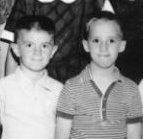
Billy and I grew up together. The next year we went to the same kindergarten at the Methodist church and our mothers took turns driving us. We went to the same school and walked together most days. We were in the same Cub Scout troop (my mom was the den mother). We went trick-or-treating together on Halloween every year. Billy was a lovable goofball. He was an occasional class clown. He was the kid who crossed his eyes and stuck out his tongue for the class picture.

Billy was also a tough little guy who occasionally had to knock a bully off of me. He had a heart. When I had a concussion from a tricycle accident, he gave me his Etch-a-Sketch. When a friend cut his foot wading in an irrigation canal--another place we were forbidden to play--Billy picked him up and carried him a block to his home and patiently explained to his mother what had happened.


Me and Billy in the third grade


Billy was never my absolute best friend, but he was never my enemy. We never fought; he was my most constant friend. That might have changed as we got older, but I moved to Alaska after the seventh grade. The changes in interests and new social structures that inevitably come with adolescence and junior high didn't have a chance to work on us. The only Billy I ever knew was the unchanging Billy of grade school. I last saw him when I passed through town for a wedding three years later. We were sixteen.

Thirty years later, I became reacquainted with David Neiwert, another veteran of the old neighborhood. David lived a block over from Billy and I and didn't arrive in the neighborhood till we were all in the fifth grade. Since David mostly remembered Billy from high school, he knew him as Bill. When I got back together with David, he told me that Bill had died the day before. Little Billy grew up to be an alcoholic who managed to drink himself to death at age forty-five.

Something strange happens when we hear that someone from our past has died. Suddenly, we want to see them, even though we might not have given them a thought for years--even thirty years. As long as we suspect someone might still be out there, they remain in an eternal state of hold. We haven't seen them and we might never see them, but we theoretically could see them if we really wanted to. They are available to us; we still have the opportunity to see them (with an unknown amount of effort). That's often enough to satisfy us. But when we find out they're gone, the opportunity is forever closed to us. That's an intolerable state.

Today would have been Billy’s fiftieth birthday. The eternal Billy of my memory should still be out there waiting for me to call him tonight and say, "fifty, eh? How did that ever happen?" We should be able to have a laugh and make an insincere promise to stay in touch.

Billy, dammit, why did you ever stop being the goofy kid of my memory and become a grown-up Bill faced with grown-up temptations and grown-up frustrations? Why aren't you still sitting by the little canal, watching the water-skippers, and hoping we don't get caught by our mothers? Why aren’t you waiting for my phone call?
Meanwhile in Florida...
A new poll has Katherine Harris forty five points behind Bill Nelson in the race for Nelson's Senate seat. I'm sure you've all been following Harris' highly entertaining race, with her weekly staff replacements and legal problems. The party has begged her to drop out of the race. The only real question now is whether or not she will manage to beat Alan Keyes' disasterous showing in 2004. As of this poll she is on target to tie with Keyes.
Bad ideas in medical research
A new report by the Institute of Medicine of the National Academies of Science recommends relaxing the rules for medical research on prisoners. Looking at that story in the paper yesterday, my Clever Wife read me the headline, "Panel Suggests Using Inmates in Drug Trials." My immediate reaction was, "reword it to 'Panel Suggests Using Prisoners in Medical Experimentation' and see what reaction you get."

If my rewording brings to mind thoughts of Mengele or the Tuskeegee institute, that's good. It should. Medical research on captive and powerless groups was horribly abused in the last century. I would much rather we be over cautious on this particular ethical question that allow those kind of crimes to continue.

There is no philisophical reason why using prisoners should be different from using any other group, say grad students or soldiers. From the researchers' point of view there are some special advantages in using prisoners, all of which relate to control and observation. With prisoners it is easy to know what they ate, when they slept, and how much they exercised. A prisoner isn't going to complicate things by taing a vacation and suddenly changing his habits for ten days. However, the very things that make a prisoner an ideal practical subject make them an unacceptable ethical risk.

The ethical problem rests on the question of coercion. In any kind of human medical trials, the experimental subjects must be fully informed going in and free to back out at any time. I can see no way to guarentee that the choice made by someone in a totally coercive environment, like a prison, is ever completely free. Lindsay Bayerstein explains the issues in detail:
Even if there are no explicit incentives to participate, inmates may still interpret a request to participate as an implied order. It is unethical to create a situation in which prisoners may sign on to a risky research project out of fear of reprisal (well-founded, or not). Prisoners often lack access to basic medical care and may be pressured into accepting experimental treatments because they can't obtain standard medical care.

Then there's the thorny issue of payment. On the one hand, free research subjects are frequently paid for their participation. If free subjects are getting paid, prisoners deserve the going rate. However, paying prisoners raises its own ethical complications. Risky medical experiments might be disproportionately attractive to people who have no other opportunities to make money.

Unlike children, prisoners are social outcasts. The institutional review board is not a loving parent who weighs the costs and benefits for individuals. Even the most thorough and conscientious committee would be making calculations on behalf large numbers of strangers from a marginalized group. The decisions of the review boards may be colored by society's disdain for prisoners. I doubt these committees will be as solicitous of the well-being of inmates as individual parents are about the welfare of their sick children.

Currently, prisoners do participate in low risk drug trials. Until we can completely guarentee a system of ethical safeguards for the prisoners' basic human rights and individual interests, we should not move into riskier areas of research. And, to repeat myself, I don't see how we can make that guarentee.

Other blogs are also discussing this.