Wednesday, July 26, 2006

WOOLLY MAMMOTH LINKED TO SCIENCE FRAUD!!!
What a sad day this is for mammothophiles everywhere:
Disgraced scientist Hwang Woo-suk, whose team became an international laughingstock after they faked their entirety of their embryonic stem cell research, appeared in court on Monday in a trial about charges that he embezzled public and private research funds. Hwang admitted he spent more than one million in attempting to clone a mammoth.

Hwang was indicted in May by South Korean government prosecutors who say that Hwang misspent public and private dollars intended for research.

On Monday, Hwang admitted he spent part of the money, some $1.05 million in failed attempts to clone mammoths, extinct members of the elephant family.

"We secured mammoth tissues from glaciers and tried cloning three times, but failed," Hwang said.

Hwang indicated South Korea's powerful SK Group gave his research team the money and that it was intended for "peripheral activities related to the research."

In his original case of scientific fraud and in his alleged current financial misdeeds, Hwang has claimed that junior members of his research team lied to him. I wonder if they lied to him about the mammoth tissue as well. None of the known frozen mammoths, or other frozen extinct quaternary mammals, was found in a glacier. All were found encased in frozen mud or silt. The image of frozen animals in glaciers--usually crystal clear ice with the animal caught in mid-stride looking rather surprised--is the stuff of cartoons with no more basis in reality than not falling till you look down or Acme Catalog products. The only way to get the surprised looking animal in clear ice is to use a freeze ray.

Tuesday, July 25, 2006

Help, please
Kos got this piece of hate mail after appearing on Nightline last night.
I think if a Democarat would be in office right now we would probbaly lose more freedoms then we already have because they would have abrought the troops home. Everyone has to realize that freedom is not free. The only reason we went to war with the Taliban is because they were hovering Al Qaida which was the terrorist organization that planeded and carried out the 9/11 attacks and killed over 3,000 Amerciacans.

While I can sort through most of the bad spelling, I'm completely stumped by the Taliban "hovering Al Qaida." I don't think he means that the Taliban was levitating Al Qaida. Does anyone have the slightest idea what he was trying to say? Is this some kind of regionalism that I'd understand if I travelled more to some of the scarier parts of this great land of ours?

Sunday, July 23, 2006

Dershowitz butters the slippery slope
Although I have been aware of him since the late eighties, I never really though about Alan Dershowitz enough to form an opinion of him one way or the other. When I worked in bookstores he was just a name on a book. I knew what section to shelve him in and where to point the customers. I don't follow most crime news, so his career as a celebrity lawyer never had much influence on me. This has changed since 9/11. Now I do have an opinion of Dershowitz and it is not a good opinion.

Within weeks of 9/11, Dershowitz was making the rounds talking about legalizing torture. By January, he had a book out on the subject. This was not the result of a sudden conversion for Dershowitz; he had been advocating such a thing for years for Israel. Now, Dershowitz wants to get rid of the restriction on collective punishment. Like the ban on torture, this is one of the foundations of international law and a benchmark of civilized behavior.

Dershowitz's tone is seductive. He doesn't come across as bloodthirsty or unhinged. He thinks the unthinkable in a rational and slightly sad manner.

On legalizing torture:
In my new book, "Shouting Fire: Civil Liberties in a Turbulent Age," I offer a controversial proposal designed to stimulate debate about this difficult issue. Under my proposal, no torture would be permitted without a "torture warrant" being issued by a judge.

He just wants to "stimulate debate about this difficult issue." What could be more reasonable than that?

On legalizing collective punishment:
The news is filled these days with reports of civilian casualties, comparative civilian body counts and criticism of Israel, along with Hezbollah, for causing the deaths, injuries and "collective punishment" of civilians. But just who is a "civilian" in the age of terrorism, when militants don't wear uniforms, don't belong to regular armies and easily blend into civilian populations?

We need a new vocabulary to reflect the realities of modern warfare. A new phrase should be introduced into the reporting and analysis of current events in the Middle East: "the continuum of civilianality."

Again, he just wants to move the discussion along by providing us with better language for debate.

The result of his rational discussion in both cases will be the same: we will legalize something that was previously unthinkable and illegal. Worse than simply legalizing the reprehensible, Dershowitz's "discussion" framework creates a poisonous moral atmosphere.

Take torture. The argument for torture always rests on the ticking bomb scenario. We know that there is a powerful bomb somewhere that will kill many people. We know that our prisoner knows where the bomb is. We are running out of time. For the moment, leave out any question of the effectiveness of torture or the likeliness of the scenario ever happening. If they thought it would work, most people would torture in these circumstances. No one would let thousands die if they thought a few slaps and cigarette burns could save them. No jury would convict them, and even if one would, we still have pardons and clemency. By keeping torture illegal, we make a statement about who we are as a people and, more importantly, who we are not. The moment we legalize torture — even in the most restricted circumstances, even if we haven't used it yet — we have become a torturing people.

Now the slippery slope argument enters. What if it's only a small bomb? What if we're not sure there's a bomb, but the prisoner knows; do we torture to find out for sure that there is no bomb? What is the prisoner resists torture; do we go after his loved ones? Do we then limit ourselves only to adults or go after his children? Wouldn't it be more affective to start with the children? What is one child compared to thousands? What if the bomb isn't going to kill anyone, but will cause millions in damage?

Dershowitz's "continuum of civilianality" creates the same fog around collective punishment.
There is a vast difference — both moral and legal — between a 2-year-old who is killed by an enemy rocket and a 30-year-old civilian who has allowed his house to be used to store Katyusha rockets. Both are technically civilians, but the former is far more innocent than the latter. There is also a difference between a civilian who merely favors or even votes for a terrorist group and one who provides financial or other material support for terrorism.

[...]

But the recognition that "civilianality" is often a matter of degree, rather than a bright line, should still inform the assessment of casualty figures in wars involving terrorists, paramilitary groups and others who fight without uniforms — or help those who fight without uniforms.

[...]

Hezbollah and Hamas militants... are difficult to distinguish from those "civilians" who recruit, finance, harbor and facilitate their terrorism. Nor can women and children always be counted as civilians, as some organizations do. Terrorists increasingly use women and teenagers to play important roles in their attacks.

The Israeli army has given well-publicized notice to civilians to leave those areas of southern Lebanon that have been turned into war zones. Those who voluntarily remain behind have become complicit. Some — those who cannot leave on their own — should be counted among the innocent victims.

If the media were to adopt this "continuum," it would be informative to learn how many of the "civilian casualties" fall closer to the line of complicity and how many fall closer to the line of innocence.

Every civilian death is a tragedy, but some are more tragic than others.

Notice again that he's not actually advocating changing international law; he's just suggesting a better vocabulary to move the discussion along. But, he's moving the discussion in a direction that will result in changing, or disregarding, an important international law. The slippery slope is just as dangerous and ugly here as it is with torture. If everyone might be a little guilty then we need show no restraint or feel any guild about killing anyone who gets in the way of our pursuing legitimate targets. While his tone is rational and reluctant, the result is the same as if he were a bloodthirsty Malkin clone calling for genocide.

Dershowitz's articles have not been the causes of these two international standards falling away. The Bush and Sharon/Olmertz governments were already breaking, or planning to break, these international laws before Dershowitz wrote. However, by muddying or disposing of previously clear limits to moral behavior, Dershowitz provided rhetorical and moral cover for the enthusiastic torturers and war criminals to go ahead.

And the damage goes beyond that. Dershowitz’s framework that we should discuss these things (as a prelude to discarding them) undermines the whole idea of rule of law and standards of civilized behavior. What should be absolute boundaries are now merely temporary obstructions to be handled by skillful negotiation.

Dershowitz once had a reputation as some kind of civil liberties advocate and liberal. Maybe it was once deserved, but no more. Now he’s just another scared "realist" enabling the dismantling of three hundred years of Enlightenment civilization and cheering on the coming darkness.

Saturday, July 22, 2006

Scientists have no morals
If anyone has wondered why Republicans have become so anti-science in recent years, Rick Santorum explains it. It's because those scientists have no morals.
Most scientists unfortunately, those that certainly are advocating for this [embryonic stem cell research], and many others feel very little moral compulsion. It's a utilitarian, materialistic view of doing whatever they can do to pursue their desired goals.

Republicans like Santorum have lots of moral compunctions and only do what's right.

Thanks, Rick. I'm glad you cleared that up for us.
Goodbye Ralph, please
Here is one of the stories that I didn't get around to commenting on during the week.

On Tuesday, Ralph Reed was defeated in his quest to become the next Lt. Governor of Georgia. The vote wasn't even close and it couldn't have happened to a more deserving guy. Reed's background includes a stint in the College Republicans*, getting fired from his college paper for plagiarism, a stint as an anti-abortion protestor, head of the Christian Coalition, dirty tricks in various elections from his college days forward, and money laundering for his old roommate Jack Abramoff. His people are saying that his loss is somehow the fault of sabotage by John McCain. If that's true, we all owe McCain our thanks.

Lt. Governor of Georgia might be a do-nothing job, but Reed has his eyes firmly set on the White House and this was an important step in that direction. As Lt. Governor, Reed would have been able to get press attention and would have been well positioned to be annonted as the front runner for governor when Sonny Pudue is term-limited out of office. As the last century has shown, governorships are the best path to the White House. As Reed is barely forty-five, we shouldn't count ourselves safe from him yet. He says we won't have Ralph to kick around anymore, but I don't belive it. He will return.

* Since the College Republicans is nothing more than a school in dirty tricks for future corrupt politicians, isn't it about time the whole thing was declared a criminal enterprise under RICO and shut down?
For your weekend reading
A new Carnival of Bad History is up over at Hiram Hover's.

In one of the posts, Wilson, The Elfin Ethicist, provides us with rules for writing tendentious history.
  • First, make no effort to develop historical research and interpretation sensibilities apart from your particular ideological project. Jump right in.
  • Evaluate the reliability of any source according to whether it corroborates your opinions.
  • Make no distinction between facts and interpretation. In any case, remember that the truth of the latter determines the truth of the former.
  • Assume that ulterior motives lie behind the work of any scholars who disagree with you.
  • Project today's political battles onto your ancestors' lives.
  • Use nice round numbers. Then round them again. With enough rounding, any number will support your position.
  • Either adopt a position of total relativism or ignore context altogether. Switch sides as appropriate.
  • Blame historical figures for failing to take into account what you know but they did not.
  • Remember that a lack of acceptance or publicity is always evidence of a conspiracy.
  • When characterizing your opponents' work, employ the term "revisionist" a lot. At the same time, obsess over how wrong the conventional understanding is.
  • Remember that "left," "right," and other sweeping political labels always provide accurate insight into individual opinions. Everyone within the Left or the Right thinks and acts alike, for all practical historical purposes.
  • Always think of yourself as politically incorrect. At the same time, always think of your detractors as fringe radicals.
  • If you must read the things your opponents write, read only the stuff that uses the most pejorative language. This will provide inspiration and spice up your prose, as well.
  • Never, ever consider the remote possibility that your detractors are intelligent people speaking in good faith.

With only a few modifications, these same rules could be used by aspiring political pundits, creationist defenders, greenhouse skeptics, or really any current events blogger. I plan to hang them over my computer.

Friday, July 21, 2006

Kumbaya, man, kumbaya
People who consider themselves political realists--people like libertarians and neo-cons--like to strike a tough, no nonsense pose that includes macho sayings that demonstrate their seriousness and complete lack of sentimentalism or idealism. One of my least-favorite of these sayings is: "No one ever stopped a war by singing folk songs." I think this shows a dangerous overconfidence in their powers of historical analysis. Does anyone know for sure that singing folk songs never stopped a war? Can we know for sure the complete and total causes of any human even?

Real life is complicated. Really, really complicated. Chaos mathematicians regularly demonstrate how a flatulent butterfly in the Amazon can cause hurricanes and crop failures half-way around the world. When considering the full complexity of the world can anyone guarantee that singing folk songs didn't stop a war, or contribute just a little to stopping a war? I don't think they can. Maybe those realists shouldn't be so smug about their so-called seriousness. Maybe we all owe the folksingers a little more respect.

Wednesday, July 19, 2006

Not dead yet
See, I told you I wouldn't get much blogging done this month. The changeover to my new job responsibilities will continue to be crazy for about another week before it settles into a routine. I took over the new job just in time to get handed a series of short deadline projects. I spent last weekend with a park full of belly dancers (yes, there's a story; yes, I'll tell it). That was a one time distraction from weekend blogging. I promise I'll get something up this weekend, maybe even the latest mammoth story.

Sunday, July 09, 2006

Happy birthday, Nick
Today is the 150th anniversary of Nikola Tesla, one of the great geniuses of the era of electrical invention and a favorite figure of numerous schools of conspiracy theory. If neither of those is a good enough reason for celebration, then you should raise a glass just for the excuse to use the word sesquicentennial in a sentence. Those don't come along every day you know.

Tesla was a Serb born the village of Smiljan in a district called Lika, in what was then called the Croatian Military Frontier of the Habsburg Empire. Before Tesla was an adult, the Habsburg Empire became Austria-Hungary and the Military Frontier was absorbed into Croatia proper (which was itself part of the Hungarian half of the empire). Tesla was not especially interested in politics, but the successive rulers of Smiljan have politicized his memory.

After World War One, Croatia, Lika, and Smiljan were all absorbed into the new Yugoslav kingdom. During World War Two, the region was part of the Independent Croatian State (that was really its name. It's kind of pathetic when you have to put "independent" in the name of your country). The local Serbian population suffered atrocities at the hand of the local fascists, the Ustasha.

Following the War, Yugoslavia was recreated as a federation with Smiljan included in the socialist Croatian state. It was not inevitable that this would happen. Roosevelt thought that maybe Yugoslavia had been a bad idea to begin with and suggested dividing it into two parts. Stalin might have agreed, seeing advantage in a different solution for every shift in the international situation. At various times, he supported a unitary Yugoslavia, a complete break-up into tiny republics, a federal Yugoslavia, a super federation that would have included Bulgaria and Albania, and annexing the Balkans into the Soviet Union. Tito's federal state just happened to be the solution Stalin was supporting at the end of the war and the one that solidified into reality before he could change his mind.

During the break-up of Yugoslavia, Smiljan was included in the short-lived Serbian Republic of the Krajina, which seceded from Croatia. When the region was reconquered by Croatia, most of the Serbian population fled to Serbia proper. True to the nature of the region, almost every word of the preceding historical summary will be sure to offend someone's nationalist narrative.

During all of this, the memory of Nikola Tesla was something of a political football. Tesla died in 1943, before the Communists came to power in the old country. As he had few opportunities to offend them, he was adopted as a national hero. Tesla was a perfect Yugoslav icon. Both Serbia and Croatia could find reason to claim him as a native son, the former by ethnicity and the latter by geography. There were Tesla museums and Tesla statues in both Belgrade and Zagreb. Tesla was shown on the currency of the Yugoslav Federation.

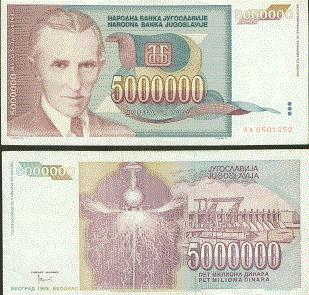
When I visited Belgrade in 1993 to interview Milovan Djilas, the economy was in the final stage of a total collapse under runaway inflation. A liter of beer cost a hundred million dinars at the hotel I stayed in. To keep up with the rising prices, the government mint introduced a new bigger bill every couple weeks and stopped printing some of the smaller ones. Seeing that I was interested in the currency, one of the refugees living at the hotel gave me a handful of obsolete bills for souvenirs. With enough old bills, it was easy to see how the mint could get new denominations into circulation so quickly. They simply reused the designs and changed the numbers, colors, and, in some cases, shuffled the designs on the back. The child who appeared on the 50,000 dinar note with a green background and roses on the back reappeared on the one million dinar note with an orange background and an iris on the back. I still have a few five million dinar notes with Tesla on them.

This was in the Serbian remainder of Yugoslavia. In Croatia, his statue was blown up, and the house where he was born was allowed to fall into ruin. Now the Balkans are moving on to another era. The leaders of Croatia and Serbia are looking for causes to bring them back together. Tesla is available for the job.

The Croatian government has spent $8.75 million restoring Tesla's house and the presidents of Croatia and Serbia will both be present to dedicate it as a museum today. In Zagreb, the Croats are unveiling a new statue and name a street after Tesla. In Belgrade, the Serbs are renaming the airport Nikola Tesla International.
Five million Teslas
Coturnix, whose secret identity is Bora Zivkovic, will be celebrating the Nikola Tesla sesquicentenial tomorrow. For two weeks now he has been having a countdown of sorts to the birthday of one of Serbia's proudest sons. Coturnix has given us a constant stream of Tesla quotes and scientific trivia. I'll contribute a Tesla post to the fun.

In late August 1993 I collected a few of these five million dinar notes in Belgrade. At the time they were worth about two-thirds of a cent American. Over the next four months they lost even more value.


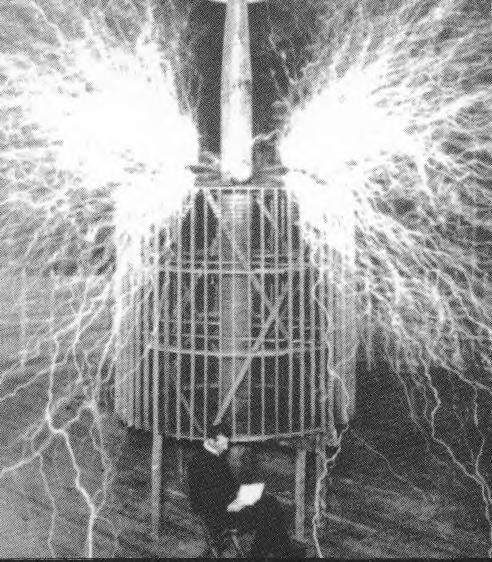
The portrait on the front of the bill is of Tesla in later life. On the back, to the right is a modern hydroelectric dam. Tesla's innovations made the long distance transmission of electricity through powerlines possible. To the left is a picture of Tesla in his lab at Colorado Springs around 1900. Unfortunately, it's almost impossible to see him in this reproduction. Below is a photo from the same series as the basis for the dinar engraving.


Tesla had a series of portraits made of him surrounded by home-made lightning. He loved the shock value of posing is such situations. Unfortunately, it contributed to his public image as a mad scientist, an image that was only confirmed in many peoples' minds as he developed obsessive/compulsive tendencies in his middle-age.

The device is an experimental magnifying transmitter, by which he hoped to broadcast electricity without wires. It is essentially a bigger version of the Tesla coils that were popular at science fairs when I was a kid.

In grade school in the early sixties, I wanted to build a Tesla coil and even had some plans from Popular Mechanics. Most of the parts were things that I could have scrounged from auto junkyards, except for one major step-up transformer. That I would have needed to buy new and the price was some unattainable amount like fifty dollars. In modern prices, that's about $136,000. You wouldn't believe how much candy you could buy for a nickel in those days. Hershey bars were the size of surf boards. Even if I had taken up a paper route, I couldn't have saved that much. [/geezer]